

“A human being is a part of the whole, called by us, “Universe,” a part limited in time and space. He experiences himself, his thoughts and feelings as something separated from the rest — a kind of optical delusion of his consciousness. This delusion is a kind of prison for us, restricting us to our personal desires and to affection for a few persons nearest to us. Our task must be to free ourselves from this prison by widening our circle of compassion to embrace all living creatures and the whole of nature in its beauty. Nobody is able to achieve this completely, but the striving for such achievement is in itself a part of the liberation and a foundation for inner security.”
— Albert Einstein
The picture below reminded me of these thoughts. Even the smallest actions effect everything else… 🙂




it’s a strange sence of humour but it’s the only one I’ve got… from http://little-people.blogspot.com/



 That’s the language used by the fastest growing religion in Jesus’ day, the Cult of Caesar. The ‘Cult of Caesar’ announced Caesar as Divine and provided the spirituality for the Empire’s invasion, colonisation, oppression and continual domination. This unnamed soldiers job was his spiritual act of worship, to oversee the brutal and public humiliation of those who would challenge the hegemonic control of the world by it’s true Lord and Son of God, Caesar, the Roman Emperor. The Empire did this through Caesar’s saving methods, means, politics, ethics and spirituality; VIOLENCE. In particular for this centurion, his job was overseeing the violence of crucifixion which made a spectacle of would be revolutionaries that would challenge Caesar as Divine Ruler of the world.
 As N.T. Wright has said,
 The early church, filled with the Holy Spirit, did just that and it often cost them there lives. Much like the unarmed actions of the Buddhist monks in Burma this week, the early church showed a fearlessness in the face of the rebellious principalities and powers. Yet unlike the monks and their brave actions (which I admire deeply) where not simply fueled by the desperation of the situation but by the resurrection of the Son of God; the dawning of God’s nonviolent dream for creation. Unquestionably they understood the cross to be what God has done for us, empowering us to “put away the sword” and to take up the cross as our way of defeating evil (as seen in the early churches refusal to fight wars for first three centuries of Christianity).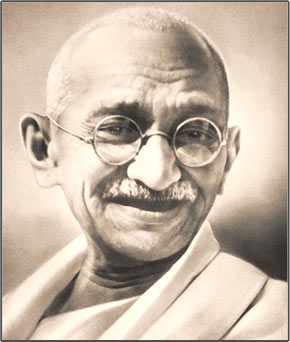


 “Because the life of Jesus has the significance and the transcendency to which I have alluded, I believe that he belongs not solely to Christianity, but to the entire world; to all races and people, it matters little under what flag, name or doctrine they may work, profess a faith, or worship a God inherited from ancestors.”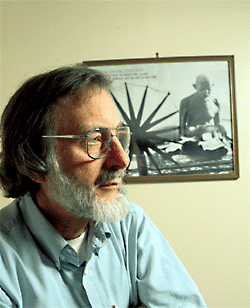
 Gandhi famously refused to become a Christian yet daily spent 2 hours meditating after reading the Jesus’ Sermon on the Mount. (Anybody know any Christians who spent 2 hours meditating on Christ’s teachings today?) Repeatedly when asked for the inspiration of his nonviolent revolution in India he would not fail to mention Jesus and his teachings. Gandhi’s dedication to Jesus and practice of his teachings cannot be doubted, nor can his dedication to his Hinduism (albeit a Hinduism that looks like Jesus. So much so Gandhi was often accused of “Christianising” Hinduism and was finally shot by someone who believed he was corrupting Hinduism.)
 He’s the kind thinker that would be interesting if he didn’t practice his ideas making him so dangerous. He the kind of guy who is an influence on many but quoted by few because of fears that they to might experience the ‘blessings of being cursed’ that are seen in his life because of the way he challenges the principalities and powers. He has a gentleness and humility that is intimidating to the shamsters who travel the speaking circuit enjoying the fanfare and praise while merely talking about what he quietly speaks with his life away from the cameras and applause. Like Gandhi he has been written off by many Christians. Not because of his witness, his life, like Gandhi’s, has become a modern day metaphor for Christ-likeness. But he has been written off for suggesting that maybe Gandhi isn’t burning in hell for not becoming a Christian (it wan’t South Park that convinced him).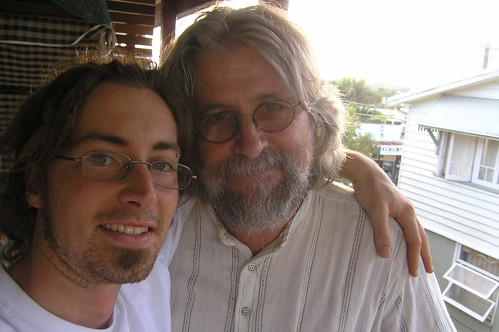



 “In my travels around the world, I see a lot to inspire cynicism -including a lot of shabby religious stuff I’d rather not even give examples of. But I also meet people who inspire hope and courage in me -emerging young leaders who “get” Jesus’ message of the kingdom of God, and who are living it and giving it away. They see the integral nature of mission – that it brings together God and humanity, humanity and creation, grace and nature, contemplation and action, evangelism and social justice, faith and politics, the making of disciples and the making of peace.